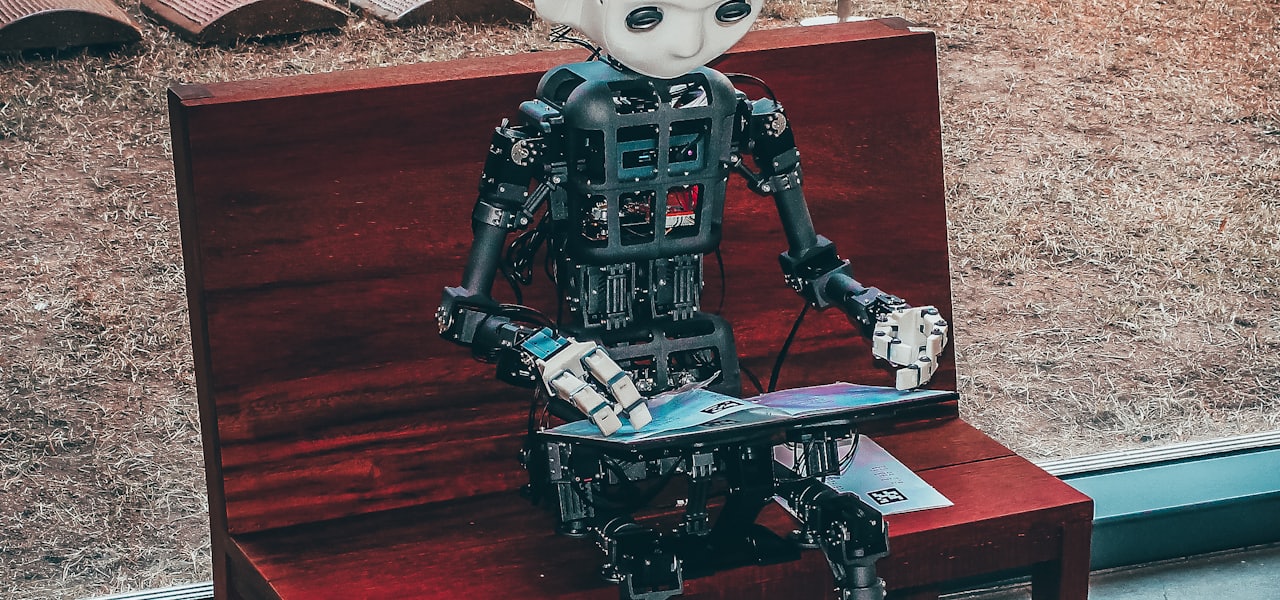
A Gödel machine is a hypothetical self-improving computer program that solves problems in an optimal way. It uses a recursive self-improvement protocol in which it rewrites its own code when it can prove the new code provides a better strategy. The machine was invented by Jürgen Schmidhuber (first proposed in 2003), but is named after Kurt Gödel who inspired the mathematical theories. The Gödel machine is often discussed when dealing with issues of meta-learning, also known as "learning to learn." Applications include automating human design decisions and transfer of knowledge between multiple related tasks, and may lead to design of more robust and general learning architectures. Though theoretically possible, no full implementation has been created. The Gödel machine is often compared with Marcus Hutter's AIXI, another formal specification for an artificial general intelligence. Schmidhuber points out that the Gödel machine could start out by implementing AIXItl as its initial sub-program, and self-modify after it finds proof that another algorithm for its search code will be better. == Limitations == Traditional problems solved by a computer only require one input and provide some output. Computers of this sort had their initial algorithm hardwired. This does not take into account the dynamic natural environment, and thus was a goal for the Gödel machine to overcome. The Gödel machine has limitations of its own, however. According to Gödel's First Incompleteness Theorem, any formal system that encompasses arithmetic is either flawed or allows for statements that cannot be proved in the system. Hence even a Gödel machine with unlimited computational resources must ignore those self-improvements whose effectiveness it cannot prove. == Variables of interest == There are three variables that are particularly useful in the run time of the Gödel machine. At some time t {\displaystyle t} , the variable time {\displaystyle {\text{time}}} will have the binary equivalent of t {\displaystyle t} . This is incremented steadily throughout the run time of the machine. Any input meant for the Gödel machine from the natural environment is stored in variable x {\displaystyle x} . It is likely the case that x {\displaystyle x} will hold different values for different values of variable time {\displaystyle {\text{time}}} . The outputs of the Gödel machine are stored in variable y {\displaystyle y} , where y ( t ) {\displaystyle y(t)} would be the output bit-string at some time t {\displaystyle t} . At any given time t {\displaystyle t} , where ( 1 ≤ t ≤ T ) {\displaystyle (1\leq t\leq T)} , the goal is to maximize future success or utility. A typical utility function follows the pattern u ( s , E n v ) : S × E → R {\displaystyle u(s,\mathrm {Env} ):S\times E\rightarrow \mathbb {R} } : u ( s , E n v ) = E μ [ ∑ τ = time T r ( τ ) ∣ s , E n v ] {\displaystyle u(s,\mathrm {Env} )=E_{\mu }{\Bigg [}\sum _{\tau ={\text{time}}}^{T}r(\tau )\mid s,\mathrm {Env} {\Bigg ]}} where r ( t ) {\displaystyle r(t)} is a real-valued reward input (encoded within s ( t ) {\displaystyle s(t)} ) at time t {\displaystyle t} , E μ [ ⋅ ∣ ⋅ ] {\displaystyle E_{\mu }[\cdot \mid \cdot ]} denotes the conditional expectation operator with respect to some possibly unknown distribution μ {\displaystyle \mu } from a set M {\displaystyle M} of possible distributions ( M {\displaystyle M} reflects whatever is known about the possibly probabilistic reactions of the environment), and the above-mentioned time = time ( s ) {\displaystyle {\text{time}}=\operatorname {time} (s)} is a function of state s {\displaystyle s} which uniquely identifies the current cycle. Note that we take into account the possibility of extending the expected lifespan through appropriate actions. == Instructions used by proof techniques == The nature of the six proof-modifying instructions below makes it impossible to insert an incorrect theorem into proof, thus trivializing proof verification. === get-axiom(n) === Appends the n-th axiom as a theorem to the current theorem sequence. Below is the initial axiom scheme: Hardware Axioms formally specify how components of the machine could change from one cycle to the next. Reward Axioms define the computational cost of hardware instruction and the physical cost of output actions. Related Axioms also define the lifetime of the Gödel machine as scalar quantities representing all rewards/costs. Environment Axioms restrict the way new inputs x are produced from the environment, based on previous sequences of inputs y. Uncertainty Axioms/String Manipulation Axioms are standard axioms for arithmetic, calculus, probability theory, and string manipulation that allow for the construction of proofs related to future variable values within the Gödel machine. Initial State Axioms contain information about how to reconstruct parts or all of the initial state. Utility Axioms describe the overall goal in the form of utility function u. === apply-rule(k, m, n) === Takes in the index k of an inference rule (such as Modus tollens, Modus ponens), and attempts to apply it to the two previously proved theorems m and n. The resulting theorem is then added to the proof. === delete-theorem(m) === Deletes the theorem stored at index m in the current proof. This helps to mitigate storage constraints caused by redundant and unnecessary theorems. Deleted theorems can no longer be referenced by the above apply-rule function. === set-switchprog(m, n) === Replaces switchprog S pm:n, provided it is a non-empty substring of S p. === check() === Verifies whether the goal of the proof search has been reached. A target theorem states that given the current axiomatized utility function u (Item 1f), the utility of a switch from p to the current switchprog would be higher than the utility of continuing the execution of p (which would keep searching for alternative switchprogs). === state2theorem(m, n) === Takes in two arguments, m and n, and attempts to convert the contents of Sm:n into a theorem. == Example applications == === Time-limited NP-hard optimization === The initial input to the Gödel machine is the representation of a connected graph with a large number of nodes linked by edges of various lengths. Within given time T it should find a cyclic path connecting all nodes. The only real-valued reward will occur at time T. It equals 1 divided by the length of the best path found so far (0 if none was found). There are no other inputs. The by-product of maximizing expected reward is to find the shortest path findable within the limited time, given the initial bias. === Fast theorem proving === Prove or disprove as quickly as possible that all even integers > 2 are the sum of two primes (Goldbach’s conjecture). The reward is 1/t, where t is the time required to produce and verify the first such proof. === Maximizing expected reward with bounded resources === A cognitive robot that needs at least 1 liter of gasoline per hour interacts with a partially unknown environment, trying to find hidden, limited gasoline depots to occasionally refuel its tank. It is rewarded in proportion to its lifetime, and dies after at most 100 years or as soon as its tank is empty or it falls off a cliff, and so on. The probabilistic environmental reactions are initially unknown but assumed to be sampled from the axiomatized Speed Prior, according to which hard-to-compute environmental reactions are unlikely. This permits a computable strategy for making near-optimal predictions. One by-product of maximizing expected reward is to maximize expected lifetime.
Tabletopia
Tabletopia is an online portal for users to play and create virtual tabletop games. The platform is developed by Tabletopia Inc and initially was released as a web browser based service after a successful crowdfunding campaign in August 2015. In December 2016 Tabletopia was released on Steam, and later in 2018 became available in AppStore and Google Play. == Gameplay == Tabletopia is a sandbox system for running any game. That means no AI or rules enforcement. Participating players will have to know how to play the game. Nevertheless, the platform has some automated actions available, like card-shuffling and dealing, dice-rolling, magnetic placement of components in special zones, hand management, and some others. Tabletopia also features ready game setups for various player numbers to facilitate gameplay. It also has customisable camera controls which let players save camera positions and switch between them using hot keys. People can use the Game Designer mode to design and create their own board games using the component library. They can then monetise the games with a 70/30 split to the game designer. == Development == Tabletopia was created in early 2014, by Tim Bokarev and his partners Artem Zinoviev and Dmitry Sergeev. These co-founders already had experience in the video and board games industry. Their other projects include Promo Interactive, an internet advertising agency, Playtox, a mobile MMORPG, Igrology, a game studio, and Tesera.ru, the main Russian-speaking board gaming portal. By Spring 2014, Artem, Dmitry and Tim created Tabletopia Inc. USA and started development. Tabletopia is a multinational crew that includes professionals from USA, Ukraine, Australia, Ireland, and Germany. The Kickstarter campaign in August 2015 earned $133,721 by 2,545 backers. Tabletopia received Green Light on Steam in September 2015 and was released on Steam in March 2016. The platform remained in Early Access until December 2016, when it was officially released on Steam and on the web. In February 2018 it was released as a stand-alone app for iOS tablets, and in September 2018 for Android tablets.
Maghi King
Margaret (Maghi) Daniel King is a retired British computational linguist known for her work on evaluating the quality of machine translation. She is an honorary professor in the Department of Translation Technology of the University of Geneva in Switzerland, and the former director of the Dalle Molle Institute for Semantic and Cognitive Studies at the University of Geneva. == Education and career == King read classics, Ancient History and Philosophy (Greats) at the University of Oxford, worked as a computer programmer, and became a lecturer in the Department of Computation at the University of Manchester Institute of Science and Technology. She moved to the Dalle Molle Institute for Semantic and Cognitive Studies (ISSCO) in 1974. In 1976, ISSCO became part of the University of Geneva, and she continued there, becoming ISSCO's director in 1978. She remained director until her retirement in 2006. == Recognition == King is a Fellow of the European Association for Artificial Intelligence (formerly ECCAI), elected in 1999.
Conversational AI Platforms Reviews: What Actually Works in 2026
Shopping for the best conversational AI platform? An conversational AI platform is software that uses machine learning to help you get more done — it keeps getting smarter as the underlying models improve. Pricing, accuracy, and the size of the model behind the tool are the three factors that most affect daily usefulness. Whether you are a beginner or a pro, the right conversational AI platform slots into your workflow and pays for itself fast. We tested the leading options and ranked them by quality, value, and ease of use.
OCR-A
OCR-A is a font issued in 1966 and first implemented in 1968. A special font was needed in the early days of computer optical character recognition, when there was a need for a font that could be recognized not only by the computers of that day, but also by humans. OCR-A uses simple, thick strokes to form recognizable characters. The font is monospaced (fixed-width), with the printer required to place glyphs 0.254 cm (0.10 inch) apart, and the reader required to accept any spacing between 0.2286 cm (0.09 inch) and 0.4572 cm (0.18 inch). == Standardization == The OCR-A font was standardized by the American National Standards Institute (ANSI) as ANSI X3.17-1981. X3.4 has since become the INCITS and the OCR-A standard is now called ISO 1073-1:1976. == Implementations == In 1968, American Type Founders produced OCR-A, one of the first optical character recognition typefaces to meet the criteria set by the U.S. Bureau of Standards. The design is simple so that it can be easily read by a machine, but it is more difficult for the human eye to read. As metal type gave way to computer-based typesetting, Tor Lillqvist used Metafont to describe the OCR-A font. That definition was subsequently improved by Richard B. Wales. Their work is available from CTAN. To make the free version of the font more accessible to users of Microsoft Windows, John Sauter converted the Metafont definitions to TrueType using potrace and FontForge in 2004. In 2007, Gürkan Sengün created a Debian package from this implementation. In 2008. Luc Devroye corrected the vertical positioning in John Sauter's implementation, and fixed the name of lower case z. Independently, Matthew Skala used mftrace to convert the Metafont definitions to TrueType format in 2006. In 2011 he released a new version created by rewriting the Metafont definitions to work with METATYPE1, generating outlines directly without an intermediate tracing step. On September 27, 2012, he updated his implementation to version 0.2. In addition to these free implementations of OCR-A, there are also implementations sold by several vendors. As a joke, Tobias Frere-Jones in 1995 created Estupido-Espezial, a redesign with swashes and a long s. It was used in a "technology"-themed section of Rolling Stone. Maxitype designed the OCR-X typeface—based on the OCR-A typeface with OpenType features, alien/technology-themed dingbats and available in six weights (Thin, Light, Regular, Medium, Bold, Black). Japanese typeface foundry Visual Design Laboratory (VDL) designed two typefaces based on the OCR-A typeface: one for Simplified Chinese characters named Jieyouti and one for Japanese characters named Yota G (ヨタG) , both available in five weights (Light, Regular, Medium, Semi Bold, Bold). == Use == Although optical character recognition technology has advanced to the point where such simple fonts are no longer necessary, the OCR-A font has remained in use. Its usage remains widespread in the encoding of checks around the world. Some lock box companies still insist that the account number and amount owed on a bill return form be printed in OCR-A. Also, because of its unusual look, it is sometimes used in advertising and display graphics. Notably, it is used for the subtitles in films and television series such as Blacklist and for the main titles in The Pretender. Additionally, OCR-A is used in the titles and subtitles for the films 13 Hours: The Secret Soldiers of Benghazi and Hoppers (film). It was also used for the logo, branding, and marketing material of the children's toy line Hexbug. == Code points == A font is a set of character shapes, or glyphs. For a computer to use a font, each glyph must be assigned a code point in a character set. When OCR-A was being standardized the usual character coding was the American Standard Code for Information Interchange or ASCII. Not all of the glyphs of OCR-A fit into ASCII, and for five of the characters there were alternate glyphs, which might have suggested the need for a second font. However, for convenience and efficiency all of the glyphs were expected to be accessible in a single font using ASCII coding, with the additional characters placed at coding points that would otherwise have been unused. The modern descendant of ASCII is Unicode, also known as ISO 10646. Unicode contains ASCII and has special provisions for OCR characters, so some implementations of OCR-A have looked to Unicode for guidance on character code assignments. === Pre-Unicode standard representation === The ISO standard ISO 2033:1983, and the corresponding Japanese Industrial Standard JIS X 9010:1984 (originally JIS C 6229–1984), define character encodings for OCR-A, OCR-B and E-13B. For OCR-A, they define a modified 7-bit ASCII set (also known by its ISO-IR number ISO-IR-91) including only uppercase letters, digits, a subset of the punctuation and symbols, and some additional symbols. Codes which are redefined relative to ASCII, as opposed to simply omitted, are listed below: Additionally, the long vertical mark () is encoded at 0x7C, corresponding to the ASCII vertical bar (|). === Dedicated OCR-A characters in Unicode === The following characters have been defined for control purposes and are now in the "Optical Character Recognition" Unicode range 2440–245F: === Space, digits, and unaccented letters === All implementations of OCR-A use U+0020 for space, U+0030 through U+0039 for the decimal digits, U+0041 through U+005A for the unaccented upper case letters, and U+0061 through U+007A for the unaccented lower case letters. === Regular characters === In addition to the digits and unaccented letters, many of the characters of OCR-A have obvious code points in ASCII. Of those that do not, most, including all of OCR-A's accented letters, have obvious code points in Unicode. === Remaining characters === Linotype coded the remaining characters of OCR-A as follows: === Additional characters === The fonts that descend from the work of Tor Lillqvist and Richard B. Wales define four characters not in OCR-A to fill out the ASCII character set. These shapes use the same style as the OCR-A character shapes. They are: Linotype also defines additional characters. === Exceptions === Some implementations do not use the above code point assignments for some characters. ==== PrecisionID ==== The PrecisionID implementation of OCR-A has the following non-standard code points: OCR Hook at U+007E OCR Chair at U+00C1 OCR Fork at U+00C2 Euro Sign at U+0080 ==== Barcodesoft ==== The Barcodesoft implementation of OCR-A has the following non-standard code points: OCR Hook at U+0060 OCR Chair at U+007E OCR Fork at U+005F Long Vertical Mark at U+007C (agrees with Linotype) Character Erase at U+0008 ==== Morovia ==== The Morovia implementation of OCR-A has the following non-standard code points: OCR Hook at U+007E (agrees with PrecisionID) OCR Chair at U+00F0 OCR Fork at U+005F (agrees with Barcodesoft) Long Vertical Mark at U+007C (agrees with Linotype) ==== IDAutomation ==== The IDAutomation implementation of OCR-A has the following non-standard code points: OCR Hook at U+007E (agrees with PrecisionID) OCR Chair at U+00C1 (agrees with PrecisionID) OCR Fork at U+00C2 (agrees with PrecisionID) OCR Belt Buckle at U+00C3 == Sellers of font standards == Hardcopy of ISO 1073-1:1976, distributed through ANSI, from Amazon.com ISO 1073-1 is also available from Techstreet, who distributes standards for ANSI and ISO
VistaCreate
VistaCreate (formerly Crello) is an online graphic design platform for non-designers, launched in 2016. As of 2022, it has more than 10 million users in 192 countries. == Overview == VistaCreate (then known as Crello) was launched in 2016 as a part of Depositphotos. In 2019, the product hit a milestone of 1 million registered users and also launched mobile apps. In 2020, the library of templates and objects became free. A music library and a background remover tool were added to the platform. In May 2021, Moufflons Basketball, in collaboration with VistaCreate, organized a poster design competition in support of gender equality in sports. In October 2021, Vistaprint acquired Crello and its parent company, Depositphotos, for a total price of $85 million. After the acquisition, Crello was rebranded to VistaCreate. Along with Vistaprint and 99designs, it became part of the new Vista parent brand. After Russia started a full-scale war on the territory of Ukraine in February 2022, VistaCreate suspended all business in Russia and Belarus. VistaCreate's team and Depositphotos gathered collections of images and templates dedicated to the war in Ukraine.
AI Text-to-image Tools Reviews: What Actually Works in 2026
In search of the best AI text-to-image tool? An AI text-to-image tool is software that uses machine learning to help you get more done — it turns a rough idea into a polished result in seconds. When choosing one, weigh output quality, pricing, export formats, and how well it fits the tools you already use. Whether you are a beginner or a pro, the right AI text-to-image tool slots into your workflow and pays for itself fast. Below we compare features, pricing, and real output so you can choose with confidence.